
When you use your prosthesis to go to work, shop, or visit family every day, one question matters before buying a foot: who will help if a part or service is needed later? Two quotations may both mention a warranty, yet the route to service, covered parts, and costs left to you can differ.
Arian’s clear advantage is support from its manufacturer in Iran. At TGEC, we provide after-sales service and Arian parts under the company’s terms. Along with the foot, you receive the manufacturer’s product support commitment. Compare that commitment separately from the brand name and purchase price of any imported model.
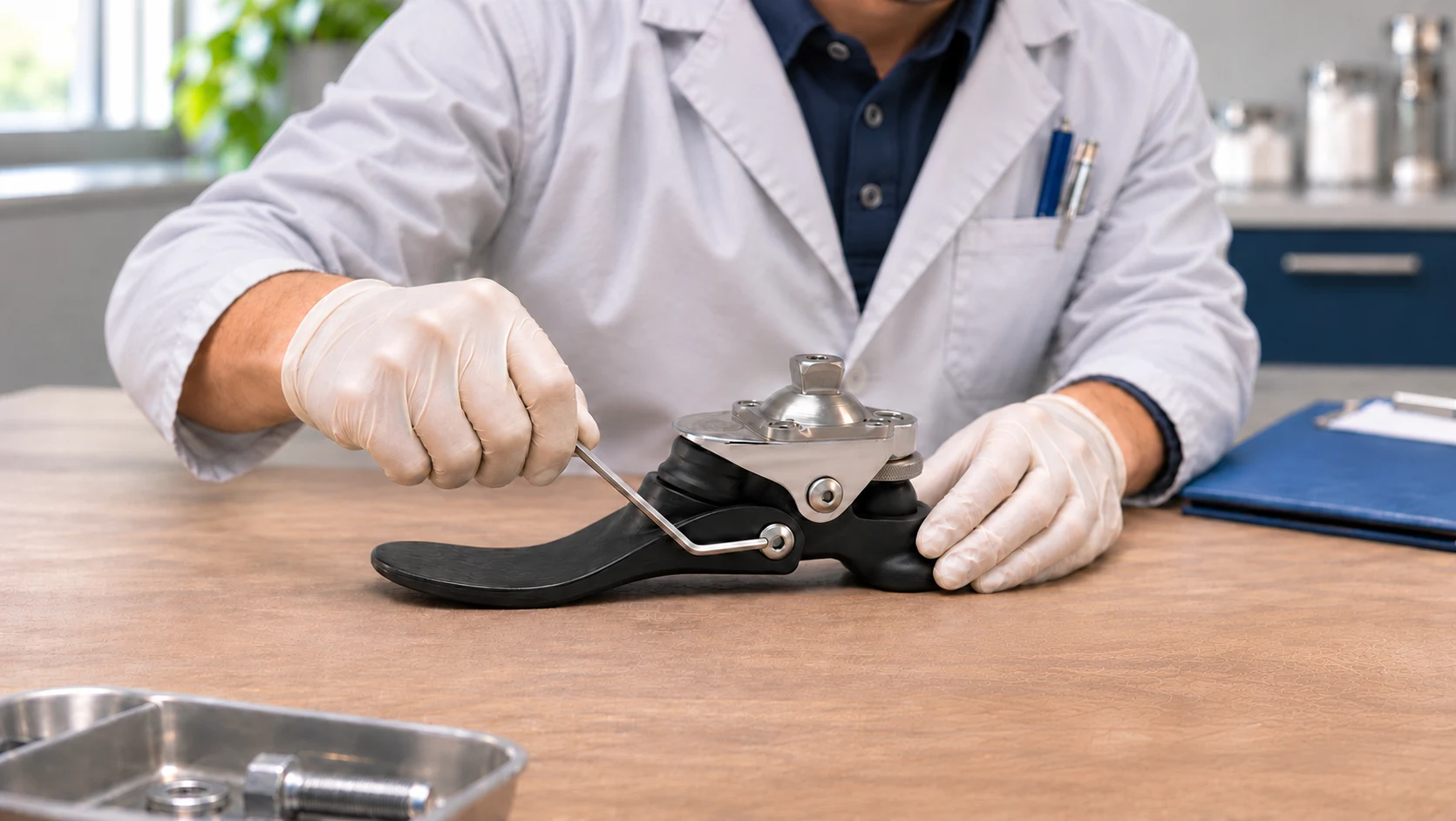
Check how an imported foot's warranty applies to your purchase
A warranty period on an overseas brand's website does not, by itself, explain how to obtain that service in Iran. Before buying, establish which company or clinic accepts a claim, whether your purchase falls within the stated coverage, and how parts are obtained or the case is referred to the manufacturer. The manufacturer's warranty and the Iranian seller's service commitment may cover different things.
For example, College Park's official warranty specifies that claims go through a prosthetist recognized by the company and require a return authorization. [1] Ask the seller to confirm the usable process for your purchase in Iran.
Some service options also depend on location. Blatchford, for example, explicitly limits its description of a loan product during service to the UK. [2] If this matters to you, ask the seller whether it is available in Iran. Information on an overseas website does not replace the service terms for your purchase.
If a seller of an imported foot offers a clear, traceable service commitment, include it in your comparison. If you are given only a brand name and warranty duration, the question of who provides service in Iran remains unanswered. Access to support depends on the model, seller, part, and supply arrangements; no single answer applies to every purchase.
With Arian, your service commitment comes directly from TGEC
TGEC offers Arian with a three-year warranty and ten years of after-sales service coverage. Arian LT has a one-year warranty and ten years of after-sales service coverage. The warranty periods differ. For either model, obtain the current terms describing covered cases and charges outside coverage with your purchase.
The value of this support is knowing who is responsible for foot support and parts supply within Iran. For Arian, the product manufacturer is also the company making the service commitment. Consider this alongside the foot's mobility and adjustment features.
Agree on the contact route between your prosthetic clinic and TGEC at the outset. The clinic evaluates the assembly and technical need; coverage of foot and part costs must be determined under the company's terms. The clinic's specialist work and the warranty on the product are separate commitments.
Two warranties of equal length may cover different things
Start with the duration, then ask three more questions to understand which parts, services, and costs are actually covered.
1. Which part and which kind of problem are covered?
Ask separately about the foot structure, bumper, and cover. In College Park's terms, bumper and bushing coverage differs from foot shell coverage, and bumper and bushing wear has its own exception. [1] Calling a part consumable is not enough to settle the warranty question; request the terms for the product you are buying.
For Arian, also ask how the particular problem, any required part, and labor will be charged. A replaceable part makes servicing possible; whether replacement is free depends on the coverage terms.
2. When does coverage begin, and how is a claim handled?
Record the start and end dates, exact model, and proof of purchase. Ask whether you should first contact your prosthetic clinic or the service provider, what documents are needed, and who communicates the decision. Request the same clear information for Arian and the imported alternative.
3. Which costs remain beyond the part itself?
College Park's warranty distinguishes prosthesis fitting and adjustment services from its product warranty responsibility. [1] When comparing Arian with an imported model, ask separately about the part, labor, shipping, and any other charges. Obtain current prices from the provider of that service.
Service support needs compatible, serviceable parts
TGEC offers replaceable bumpers in different stiffness ranges for Arian and Arian LT. A supply of compatible bumpers supports this feature over time, both when a worn part needs attention and when a specialist reviews the part selection. For a serviceable imported model, ask where compatible parts come from and on what terms they are supplied.
A specialist should select and replace a bumper according to actual weight and activity, within the model's permitted limits. A stiffer bumper or a higher stated activity level does not automatically make a foot better. Replacing a bumper does not raise the permitted weight limit or automatically change the foot's technical category. Read the bumper adjustment guide for details.
Include service time in the purchase decision
For someone who uses a prosthesis daily, work and travel plans matter. Ask where an assessment takes place, whether the foot or prosthesis must be left for a period, and how the service time will be estimated. NHS England's prosthetic service specification notes that a major repair may require a limb to remain in a workshop and a component to be ordered from its manufacturer. [3]
Local support identifies a point of contact and a supply route; ask how long your particular service will take. For travel planning, ask TGEC about part availability and the expected handling time for your request. If you need a temporary solution, ask your clinic whether one is possible and what it costs; do not assume it will be available.
If the right foot for you needs both adjustment options and support in Iran, compare Arian seriously. To obtain the current price, warranty terms, and service route for Arian or Arian LT, tell TGEC which model your specialist recommends, then compare the answers with the terms for the specific imported model.
Frequently asked questions
Do all imported feet lack service support in Iran?
No. Check the specific model and seller. One purchase may have a clear support route while another does not. Arian's advantage is TGEC's direct commitment to service and parts under its terms, not a claim that every imported brand lacks service.
Does a longer warranty mean the foot will last longer?
A warranty period is the time span of a warranty commitment. Useful foot life depends on its technical condition, how it is used, and specialist assessment. Ten years of service coverage is not a guaranteed lifespan for the foot or bumper, and it does not mean all services are free.
Is replacement of a replaceable bumper always free?
No. Replaceability is a design feature. Whether a replacement is covered by warranty or has a charge depends on the product terms and the reason service is needed. Ask about coverage and any amount due before work begins.
If I buy an imported foot outside Iran, is its warranty valid here?
A brand name or overseas warranty card cannot settle that question. Before buying, ask the relevant provider whether it will accept that specific product and its documents, who handles the case in Iran, and how parts or shipping will be managed. Compare purchase costs after those service arrangements are clear.
Model selection, assessment of parts, and prosthesis adjustment require a specialist. This article helps you compare service arrangements before purchase; it does not replace the warranty terms of a specific product or an individual assessment.