
When you leave home to go shopping, placing your prosthetic foot on the ground may feel comfortable, but moving over the foot later in the step may feel difficult. Someone else may feel an impact right at initial contact. Saying “I do not feel comfortable with this foot” is a useful starting point. If you can identify when in the step the sensation occurs, however, you can explain it more clearly to your prosthetist, the specialist who makes and adjusts prostheses. In this article, we review one step on level ground in simple terms, then consider the role of the designs of Arian and Arian LT.
Three parts to help you understand a step
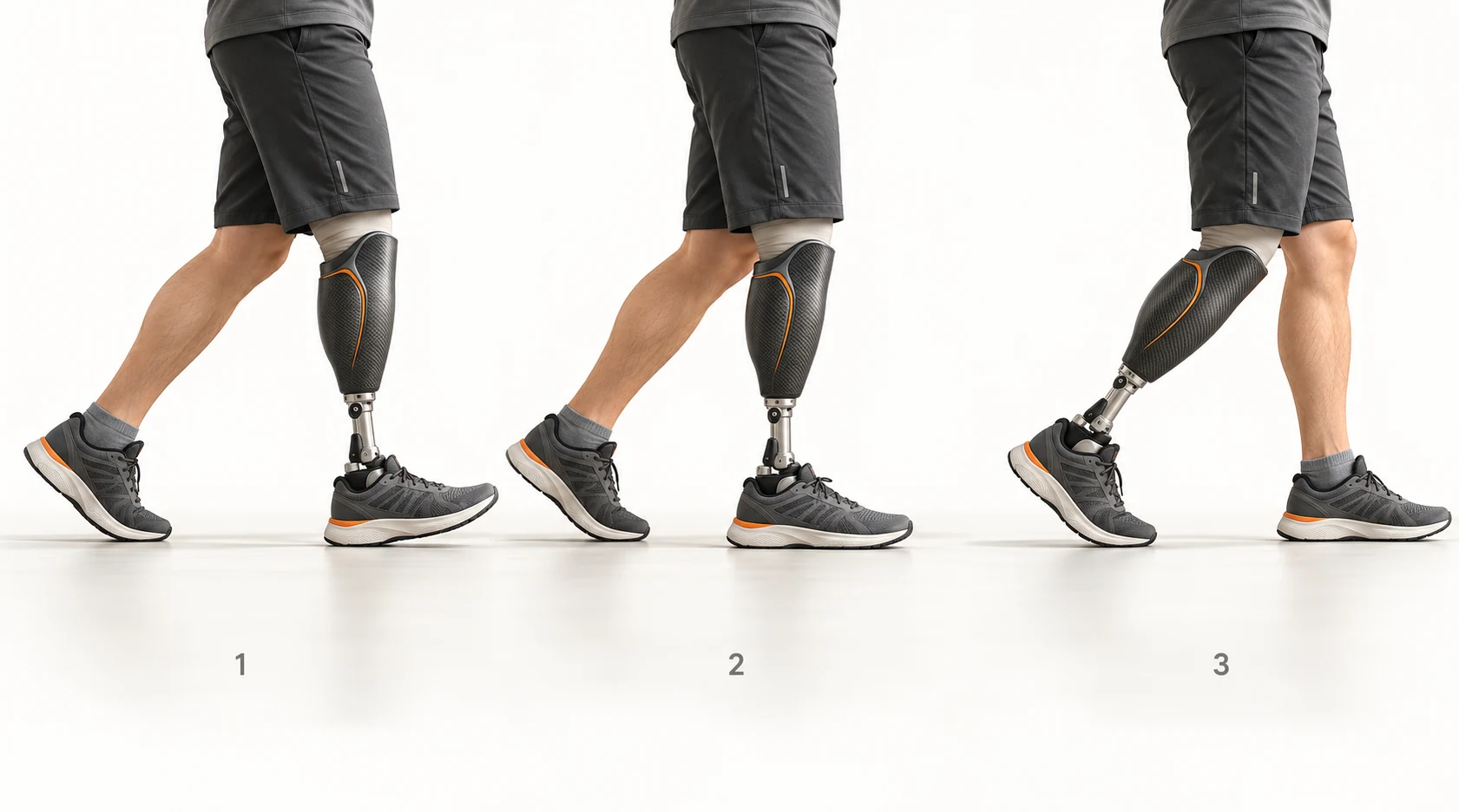
Rollover describes the body moving forward over a foot that is supporting it on the ground. To picture it, think of three moments: heel contact and the forefoot lowering; the lower leg moving forward over the supporting foot; and the heel rising as load transfers toward the forefoot. These are three parts of one continuous movement, rather than three separate stops or exercise instructions. The natural foot is often described in terms of heel, ankle, and forefoot rockers. In a prosthesis, this progression is achieved through the mechanisms and deformation of artificial components, rather than the same natural joints and muscles. [1]
1 Heel contact and the foot gradually settling onto the ground
During typical walking on level ground, the heel contacts the ground first, then the forefoot lowers so that the foot can provide support. At the same time, the load on the leading foot increases. [1] In Arian, the heel and the flexible foot assembly shape the response to initial loading. At TGEC, we designed Arian’s bumper system with the aim of damping impact, meaning moderating its response to a sudden load. Professional adjustment of rear bumper pressure is one way to help match the foot’s response to the individual. This adjustment does not mean that all force transmitted to the body is eliminated.
You might describe your experience by saying, “When I put my foot on the ground, the contact feels jarring,” or “I feel as though the foot comes down too quickly.” These are examples of descriptions, rather than a diagnosis that a bumper is too stiff or too soft. The specialist needs to interpret your experience alongside observing your walking and assessing the prosthetic assembly.
2 The lower leg moves forward and the body passes over the foot
The foot is still providing support on the ground, while the lower leg inclines forward relative to it and the body passes over the supporting foot. [1] In Arian, the multiaxial structure and flexible parts of the assembly allow relative movement and deformation under load. The prosthetist assesses this response together with the alignment of the whole prosthesis. Multiaxial does not refer only to forward-and-backward movement; it also includes movement in other directions.
If you feel a pause, a catching sensation, or an abrupt transition during this part of the step, explain when it happens: “I feel it after I put my foot down, as my body moves forward.” You do not need to bend the foot or change the connection angle yourself to demonstrate the problem. Socket fit, prosthetic height, and alignment are also assessed during the appointment. [3]
3 The heel rises and support moves toward the forefoot
As the body continues forward, the heel rises and more of the support transfers toward the forefoot; the foot then leaves the ground. [1] In Arian, the forefoot is loaded during this part of the step. The role of the elastic carbon component can be understood by thinking of a spring: it deforms under load, then returns toward its previous shape as the load decreases, giving back part of the stored energy. The foot is not a motor and does not produce new energy. Damping impact and returning energy are also different processes: some energy is dissipated through damping, while some can be returned. [2] [10]
What you feel during this stage cannot be described by a promotional energy-return figure alone. For discussion, a statement such as “Near the end of the step, I find it difficult to move over the forefoot” is more useful than deciding for yourself that a component needs replacing. Identifying the cause and choosing the appropriate action require a specialist’s assessment.
How does this relate to our prosthetic feet?
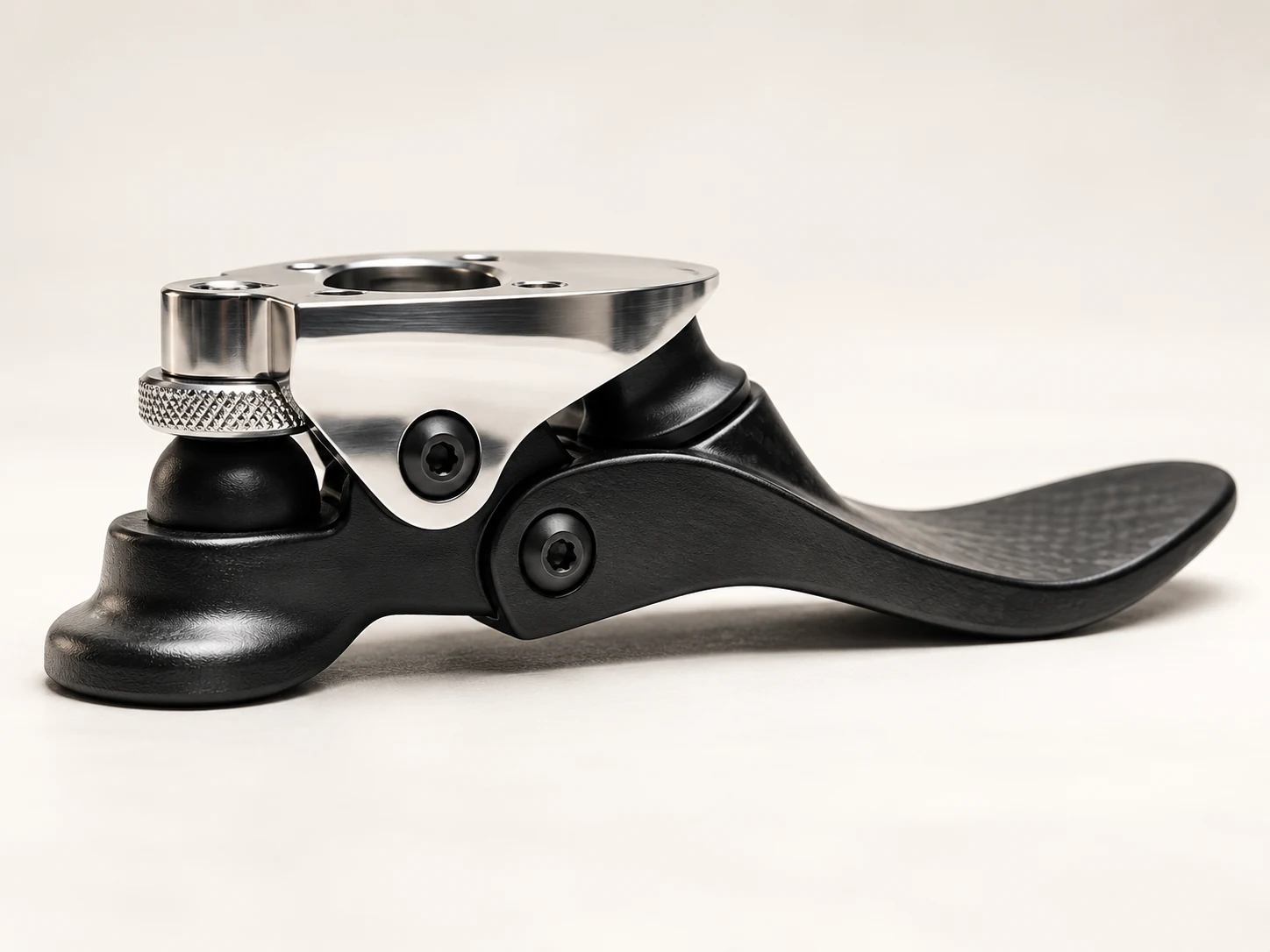
At TGEC, we manufacture Arian and Arian LT as carbon multiaxial feet with replaceable bumpers and provision for servicing. The three parts of the step described above involve the assembly working as a whole. Its selection and adjustment need to match the person’s weight, activity, and needs within the permitted limits of that model.
Arian allows rear bumper pressure adjustment. Arian LT does not have this specific adjustment, but its bumper is replaceable, and the alignment of the whole prosthesis still needs assessment. Arian’s clear distinction here is an additional adjustment option. Whether it is suitable, and what outcome it provides, must be assessed for each individual.
This understanding can help you ask a more specific question: “Which part of the assembly might be relevant to what I feel at the beginning or end of the step, and could any of my foot’s features be useful?” This brings the discussion closer to your actual needs, without deciding the cause of discomfort or the type of adjustment in advance.
Impact, residual-limb skin, and the lower back
The load from each step is transmitted to the body through the prosthetic assembly and socket. For the skin of the residual limb, sometimes called the stump, initial impact is not the only consideration. Local pressure and shear forces, which pull the skin along its surface, also matter. Pain or a wound should therefore not be attributed only to the foot; socket fit and skin condition also need assessment. [8]
Low back pain also does not have a single cause. Research has found associations between greater back-related problems and factors including a history of back pain, accompanying injuries, and residual-limb pain. Assessment of low back pain therefore needs to consider several factors, rather than only the impact at the beginning of a step. [9]
At TGEC, we consider moderating impact to be one design aim of Arian’s bumper system. This feature needs to be understood alongside appropriate foot selection, prosthetic adjustment, and skin care. It is a design capability for managing loading. Its effects on preventing wounds or low back pain require separate clinical evidence.
Include your shoes and the whole prosthesis in the discussion
A change in how walking feels may have coincided with new shoes. A difference in heel height can affect prosthetic alignment and your sense of stability. Tell the specialist which shoes you use and when you changed them, and bring the new shoes to have their compatibility assessed. For any foot, this needs to be considered against that model’s specifications. [4]
The socket, the part that holds the residual limb, and the coordination of the other components also matter. During the appointment, the specialist assesses socket fit, prosthetic height, and alignment, and observes your walking. [3] Learning to use a prosthesis is also part of rehabilitation. A physiotherapist has a role in helping you learn to walk with it. [5]
Describe your experience more clearly with three sentences
You do not need to write a technical report. Complete these three sentences with your actual experience: “I feel it when…”; “It happens more often on this route and with these shoes…”; and “It started at this time or after this change…” If you cannot identify the stage of the step, your own simple description is enough.
After the assessment, ask the specialist to explain what they observed, whether a change is needed, and how to follow up on the outcome. Do not deliberately repeat a painful or unstable movement to record the problem. If pain, a new sore area, looseness, or a noticeable change in the foot’s behavior develops, stop using the prosthesis and contact your prosthetics clinic. Do not adjust screws or bumpers yourself. [6]

Frequently asked questions
Do I have to coordinate my walking with these three stages?
No. This division is only intended to help you understand the subject and describe your experience. Ask your rehabilitation team about the walking approach and exercises appropriate for you. This article is not an exercise program.
If initial contact feels jarring, does that mean the rear bumper is too stiff?
A sensation alone cannot establish the cause. Shoes, alignment, socket fit, and the foot’s behavior need to be assessed together. Describe what you feel and leave decisions about components or adjustments to the specialist.
Does energy return mean that the foot propels me forward by itself?
In a passive foot, some of the energy applied during loading is stored and returned. This mechanism differs from a motor generating power and does not replace movement control or learning how to use the prosthesis. [2]
Does the absence of rear bumper pressure adjustment mean Arian LT cannot be adjusted?
No. This specific feature needs to be distinguished from alignment of the whole prosthesis. Arian LT does not have Arian’s rear bumper pressure adjustment, but professional assessment and adjustment of the prosthetic assembly remain necessary.
If the end of the step feels uncomfortable, should I replace the foot?
Not necessarily. The cause needs to be assessed first. In some cases, attention to fit or adjustment of the assembly may be appropriate; in others, servicing or a component change may be needed. The decision cannot be made from the foot’s name or a description of one sensation alone.
How does an adjustable bumper relate to skin and back health?
Its aim is to help manage the foot’s mechanical response, but skin and back health also depend on other factors. Assessment of the socket, skin, and cause of pain remains necessary. A design capability alone does not establish clinical prevention. [8] [9]
This article is intended to explain the foot’s role and help you have a more useful discussion with a specialist. Selection, adjustment, and walking instruction require an individual assessment.